Amateur Extra E6C: Digital logic
These are the 11 official questions in group E6C of the 2024–2028 Amateur Extra question pool, with the correct answer marked and a plain-English explanation of why it's right. The real exam asks one question from this group.
- E6C01Question 1
What is the function of hysteresis in a comparator?
- ATo prevent input noise from causing unstable output signals Correct
- BTo allow the comparator to be used with AC input signals
- CTo cause the output to continually change states
- DTo increase the sensitivity
Why: Hysteresis keeps input noise from making the output unstable.
- E6C02Question 2
What happens when the level of a comparator’s input signal crosses the threshold voltage?
- AThe IC input can be damaged
- BThe comparator changes its output state Correct
- CThe reference level appears at the output
- DThe feedback loop becomes unstable
Why: When the input crosses the threshold, the comparator's output changes state.
- E6C03Question 3
What is tri-state logic?
- ALogic devices with 0, 1, and high-impedance output states Correct
- BLogic devices that utilize ternary math
- CLogic with three output impedances which can be selected to better match the load impedance
- DA counter with eight states
Why: Tri-state logic has 0, 1 and high-impedance outputs.
- E6C04Question 4
Which of the following is an advantage of BiCMOS logic?
- AIts simplicity results in much less expensive devices than standard CMOS
- BIt is immune to electrostatic damage
- CIt has the high input impedance of CMOS and the low output impedance of bipolar transistors Correct
- DAll these choices are correct
Why: BiCMOS has CMOS's high input impedance and bipolar's low output impedance.
- E6C05Question 5
Which of the following digital logic families has the lowest power consumption?
- ASchottky TTL
- BECL
- CNMOS
- DCMOS Correct
Why: CMOS has the lowest power consumption.
- E6C06Question 6
Why do CMOS digital integrated circuits have high immunity to noise on the input signal or power supply?
- ALarge bypass capacitance is inherent
- BThe input switching threshold is about twice the power supply voltage
- CThe input switching threshold is about half the power supply voltage Correct
- DBandwidth is very limited
Why: CMOS switches at about half the supply voltage, giving wide noise margins.
- E6C07Question 7
What best describes a pull-up or pull-down resistor?
- AA resistor in a keying circuit used to reduce key clicks
- BA resistor connected to the positive or negative supply used to establish a voltage when an input or output is an open circuit Correct
- CA resistor that ensures that an oscillator frequency does not drift
- DA resistor connected to an op-amp output that prevents signals from exceeding the power supply voltage
Why: Pull-up and pull-down resistors set a voltage when a pin would otherwise float.
- E6C08Question 8
In Figure E6-3, which is the schematic symbol for a NAND gate?
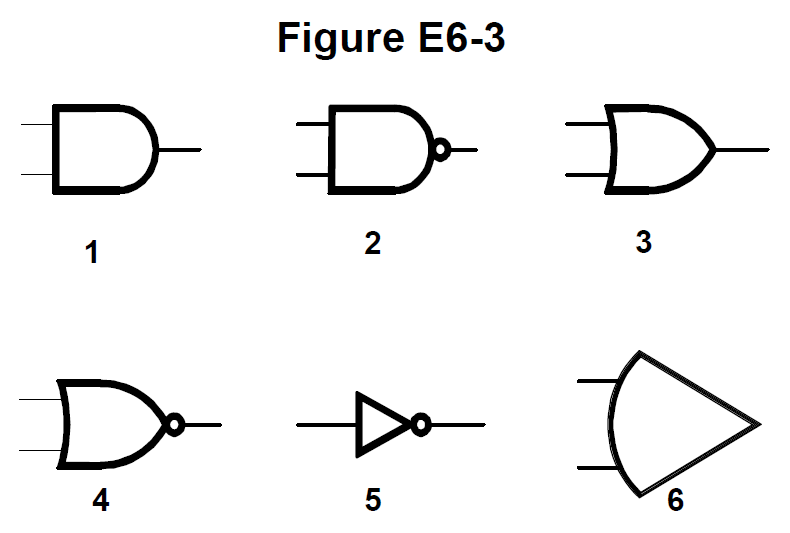
- A1
- B2 Correct
- C3
- D4
Why: Symbol 2 in E6-3 is a NAND gate.
- E6C09Question 9
What is used to design the configuration of a field-programmable gate array (FPGA)?
- AKarnaugh maps
- BHardware description language (HDL) Correct
- CAn auto-router
- DMachine and assembly language
Why: FPGAs are configured with a hardware description language (HDL).
- E6C10Question 10
In Figure E6-3, which is the schematic symbol for a NOR gate?
- A1
- B2
- C3
- D4 Correct
Why: Symbol 4 in E6-3 is a NOR gate.
- E6C11Question 11
In Figure E6-3, which is the schematic symbol for the NOT operation (inversion)?
- A2
- B4
- C5 Correct
- D6
Why: Symbol 5 in E6-3 is a NOT gate (inverter).