Amateur Extra E6B: Diodes
These are the 11 official questions in group E6B of the 2024–2028 Amateur Extra question pool, with the correct answer marked and a plain-English explanation of why it's right. The real exam asks one question from this group.
- E6B01Question 1
What is the most useful characteristic of a Zener diode?
- AA constant current drop under conditions of varying voltage
- BA constant voltage drop under conditions of varying current Correct
- CA negative resistance region
- DAn internal capacitance that varies with the applied voltage
Why: A Zener holds a constant voltage as current varies.
- E6B02Question 2
Which characteristic of a Schottky diode makes it a better choice than a silicon junction diode for use as a power supply rectifier?
- AMuch higher reverse voltage breakdown
- BMore constant reverse avalanche voltage
- CLonger carrier retention time
- DLower forward voltage drop Correct
Why: A Schottky diode's lower forward drop makes it a more efficient rectifier.
- E6B03Question 3
What property of an LED's semiconductor material determines its forward voltage drop?
- AIntrinsic resistance
- BBand gap Correct
- CJunction capacitance
- DJunction depth
Why: An LED's forward voltage depends on its material's band gap.
- E6B04Question 4
What type of semiconductor device is designed for use as a voltage-controlled capacitor?
- AVaractor diode Correct
- BTunnel diode
- CSilicon-controlled rectifier
- DZener diode
Why: A varactor diode acts as a voltage-controlled capacitor.
- E6B05Question 5
What characteristic of a PIN diode makes it useful as an RF switch?
- AExtremely high reverse breakdown voltage
- BAbility to dissipate large amounts of power
- CReverse bias controls its forward voltage drop
- DLow junction capacitance Correct
Why: A PIN diode's low junction capacitance makes it a good RF switch.
- E6B06Question 6
Which of the following is a common use of a Schottky diode?
- AIn oscillator circuits as the negative resistance element
- BAs a variable capacitance in an automatic frequency control circuit
- CIn power supplies as a constant voltage reference
- DAs a VHF/UHF mixer or detector Correct
Why: Schottky diodes are common VHF/UHF mixers and detectors.
- E6B07Question 7
What causes a junction diode to fail from excessive current?
- AExcessive inverse voltage
- BExcessive junction temperature Correct
- CInsufficient forward voltage
- DCharge carrier depletion
Why: Excessive current overheats the junction and destroys it.
- E6B08Question 8
Which of the following is a Schottky barrier diode?
- AMetal-semiconductor junction Correct
- BElectrolytic rectifier
- CPIN junction
- DThermionic emission diode
Why: A Schottky barrier diode is a metal-semiconductor junction.
- E6B09Question 9
What is a common use for point-contact diodes?
- AAs a constant current source
- BAs a constant voltage source
- CAs an RF detector Correct
- DAs a high-voltage rectifier
Why: Point-contact diodes are used as RF detectors.
- E6B10Question 10
In Figure E6-2, which is the schematic symbol for a Schottky diode?
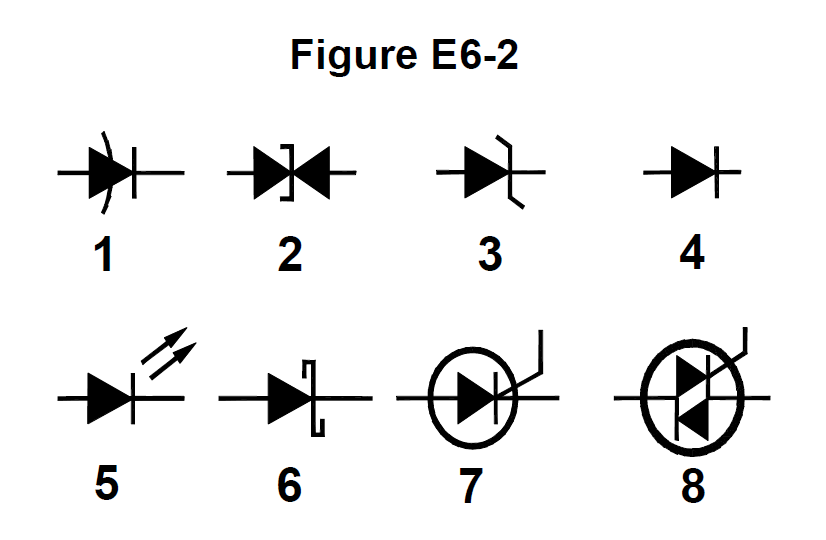
- A1
- B6 Correct
- C2
- D3
Why: Symbol 6 in E6-2 is a Schottky diode.
- E6B11Question 11
What is used to control the attenuation of RF signals by a PIN diode?
- AForward DC bias current Correct
- BA variable RF reference voltage
- CReverse voltage larger than the RF signal
- DCapacitance of an RF coupling capacitor
Why: Forward DC bias current controls a PIN diode's attenuation.