Amateur Extra E9G: The Smith chart
These are the 11 official questions in group E9G of the 2024–2028 Amateur Extra question pool, with the correct answer marked and a plain-English explanation of why it's right. The real exam asks one question from this group.
- E9G01Question 1
Which of the following can be calculated using a Smith chart?
- AImpedance along transmission lines Correct
- BRadiation resistance
- CAntenna radiation pattern
- DRadio propagation
Why: A Smith chart can calculate impedance along transmission lines.
- E9G02Question 2
What type of coordinate system is used in a Smith chart?
- AVoltage circles and current arcs
- BResistance circles and reactance arcs Correct
- CVoltage chords and current chords
- DResistance lines and reactance chords
Why: A Smith chart uses resistance circles and reactance arcs.
- E9G03Question 3
Which of the following is often determined using a Smith chart?
- ABeam headings and radiation patterns
- BSatellite azimuth and elevation bearings
- CImpedance and SWR values in transmission lines Correct
- DPoint-to-point propagation reliability as a function of frequency
Why: Smith charts are used to find impedance and SWR in lines.
- E9G04Question 4
What are the two families of circles and arcs that make up a Smith chart?
- AInductance and capacitance
- BReactance and voltage
- CResistance and reactance Correct
- DVoltage and impedance
Why: A Smith chart is made of resistance and reactance circles and arcs.
- E9G05Question 5
Which of the following is a common use for a Smith chart?
- ADetermine the length and position of an impedance matching stub Correct
- BDetermine the impedance of a transmission line, given the physical dimensions
- CDetermine the gain of an antenna given the physical and electrical parameters
- DDetermine the loss/100 feet of a transmission line, given the velocity factor and conductor materials
Why: A common use is finding a matching stub's length and position.
- E9G06Question 6
On the Smith chart shown in Figure E9-3, what is the name for the large outer circle on which the reactance arcs terminate?
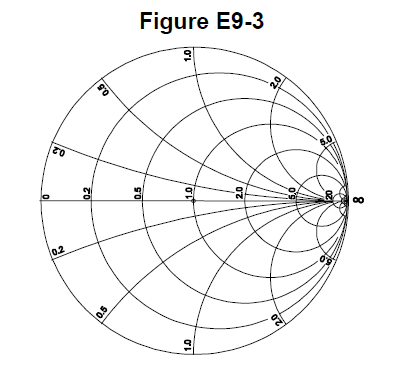
- APrime axis
- BReactance axis Correct
- CImpedance axis
- DPolar axis
Why: The large outer circle is the reactance axis.
- E9G07Question 7
On the Smith chart shown in Figure E9-3, what is the only straight line shown?
- AThe reactance axis
- BThe current axis
- CThe voltage axis
- DThe resistance axis Correct
Why: The only straight line is the resistance axis.
- E9G08Question 8
How is a Smith chart normalized?
- AReassign the reactance axis with resistance values
- BReassign the resistance axis with reactance values
- CReassign the prime center’s impedance value Correct
- DReassign the prime center to the reactance axis
Why: Normalize by reassigning the prime center's impedance.
- E9G09Question 9
What third family of circles is often added to a Smith chart during the process of designing impedance matching networks?
- AConstant-SWR circles Correct
- BTransmission line length circles
- CCoaxial-length circles
- DRadiation-pattern circles
Why: Constant-SWR circles are often added for matching design.
- E9G10Question 10
What do the arcs on a Smith chart represent?
- AFrequency
- BSWR
- CPoints with constant resistance
- DPoints with constant reactance Correct
Why: The arcs are points of constant reactance.
- E9G11Question 11
In what units are the wavelength scales on a Smith chart calibrated?
- AIn fractions of transmission line electrical frequency
- BIn fractions of transmission line electrical wavelength Correct
- CIn fractions of antenna electrical wavelength
- DIn fractions of antenna electrical frequency
Why: The wavelength scales are in fractions of electrical wavelength.