Amateur Extra E7G: Operational amplifiers
These are the 12 official questions in group E7G of the 2024–2028 Amateur Extra question pool, with the correct answer marked and a plain-English explanation of why it's right. The real exam asks one question from this group.
- E7G01Question 1
What is the typical output impedance of an op-amp?
- AVery low Correct
- BVery high
- C100 ohms
- D10,000 ohms
Why: An op-amp has very low output impedance.
- E7G02Question 2
What is the frequency response of the circuit in E7-3 if a capacitor is added across the feedback resistor?
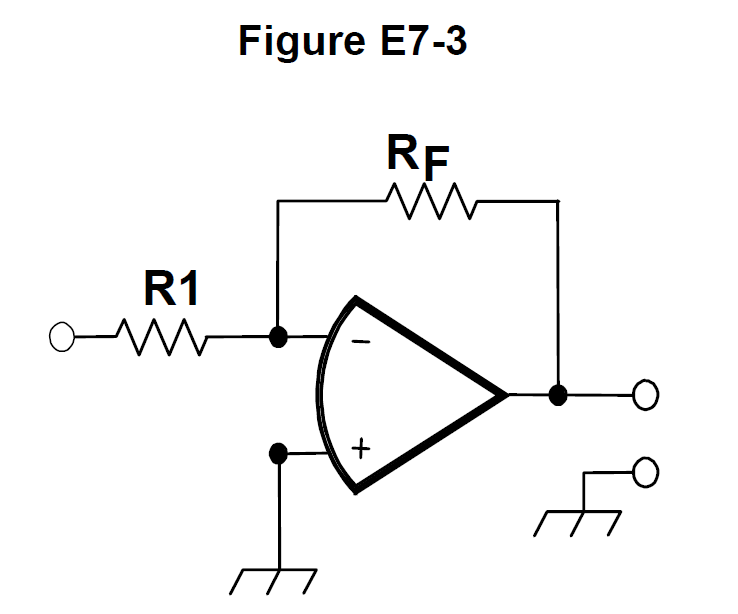
- AHigh-pass filter
- BLow-pass filter Correct
- CBand-pass filter
- DNotch filter
Why: A capacitor across the feedback resistor makes a low-pass filter.
- E7G03Question 3
What is the typical input impedance of an op-amp?
- A100 ohms
- B10,000 ohms
- CVery low
- DVery high Correct
Why: An op-amp has very high input impedance.
- E7G04Question 4
What is meant by the term “op-amp input offset voltage”?
- AThe output voltage of the op-amp minus its input voltage
- BThe difference between the output voltage of the op-amp and the input voltage required in the immediately following stage
- CThe differential input voltage needed to bring the open loop output voltage to zero Correct
- DThe potential between the amplifier input terminals of the op-amp in an open loop condition
Why: Input offset voltage brings the open-loop output to zero.
- E7G05Question 5
How can unwanted ringing and audio instability be prevented in an op-amp audio filter?
- ARestrict both gain and Q Correct
- BRestrict gain but increase Q
- CRestrict Q but increase gain
- DIncrease both gain and Q
Why: Limiting both gain and Q prevents ringing and instability.
- E7G06Question 6
What is the gain-bandwidth of an operational amplifier?
- AThe maximum frequency for a filter circuit using that type of amplifier
- BThe frequency at which the open-loop gain of the amplifier equals one Correct
- CThe gain of the amplifier at a filter’s cutoff frequency
- DThe frequency at which the amplifier’s offset voltage is zero
Why: Gain-bandwidth is where open-loop gain equals one.
- E7G07Question 7
What voltage gain can be expected from the circuit in Figure E7-3 when R1 is 10 ohms and RF is 470 ohms?
- A0.21
- B4700
- C47 Correct
- D24
Why: Gain = 470 ÷ 10 = 47.
- E7G08Question 8
How does the gain of an ideal operational amplifier vary with frequency?
- AIt increases linearly with increasing frequency
- BIt decreases linearly with increasing frequency
- CIt decreases logarithmically with increasing frequency
- DIt does not vary with frequency Correct
Why: An ideal op-amp's gain doesn't vary with frequency.
- E7G09Question 9
What will be the output voltage of the circuit shown in Figure E7-3 if R1 is 1,000 ohms, RF is 10,000 ohms, and 0.23 volts DC is applied to the input?
- A0.23 volts
- B2.3 volts
- C-0.23 volts
- D-2.3 volts Correct
Why: Gain = −10,000 ÷ 1,000 = −10, so 0.23 V gives −2.3 V.
- E7G10Question 10
What absolute voltage gain can be expected from the circuit in Figure E7-3 when R1 is 1,800 ohms and RF is 68 kilohms?
- A1
- B0.03
- C38 Correct
- D76
Why: 68,000 ÷ 1,800 ≈ 38.
- E7G11Question 11
What absolute voltage gain can be expected from the circuit in Figure E7-3 when R1 is 3,300 ohms and RF is 47 kilohms?
- A28
- B14 Correct
- C7
- D0.07
Why: 47,000 ÷ 3,300 ≈ 14.
- E7G12Question 12
What is an operational amplifier?
- AA high-gain, direct-coupled differential amplifier with very high input impedance and very low output impedance Correct
- BA digital audio amplifier whose characteristics are determined by components external to the amplifier
- CAn amplifier used to increase the average output of frequency modulated amateur signals to the legal limit
- DA RF amplifier used in the UHF and microwave regions
Why: An op-amp is a high-gain differential amplifier with very high input and very low output impedance.