Amateur Extra E5C: Plotting impedance
These are the 12 official questions in group E5C of the 2024–2028 Amateur Extra question pool, with the correct answer marked and a plain-English explanation of why it's right. The real exam asks one question from this group.
- E5C01Question 1
Which of the following represents pure capacitive reactance of 100 ohms in rectangular notation?
- A0 - j100 Correct
- B0 + j100
- C100 - j0
- D100 + j0
Why: Capacitive reactance is negative j: 0 − j100.
- E5C02Question 2
How are impedances described in polar coordinates?
- ABy X and R values
- BBy real and imaginary parts
- CBy magnitude and phase angle Correct
- DBy Y and G values
Why: Polar coordinates give magnitude and phase angle.
- E5C03Question 3
Which of the following represents a pure inductive reactance in polar coordinates?
- AA positive 45 degree phase angle
- BA negative 45 degree phase angle
- CA positive 90 degree phase angle Correct
- DA negative 90 degree phase angle
Why: Pure inductive reactance is +90 degrees.
- E5C04Question 4
What type of Y-axis scale is most often used for graphs of circuit frequency response?
- ALinear
- BScatter
- CRandom
- DLogarithmic Correct
Why: Frequency response graphs usually use a logarithmic Y axis.
- E5C05Question 5
What kind of diagram is used to show the phase relationship between impedances at a given frequency?
- AVenn diagram
- BNear field diagram
- CPhasor diagram Correct
- DFar field diagram
Why: A phasor diagram shows phase relationships.
- E5C06Question 6
What does the impedance 50 - j25 ohms represent?
- A50 ohms resistance in series with 25 ohms inductive reactance
- B50 ohms resistance in series with 25 ohms capacitive reactance Correct
- C25 ohms resistance in series with 50 ohms inductive reactance
- D25 ohms resistance in series with 50 ohms capacitive reactance
Why: 50 − j25 is 50 Ω of resistance in series with 25 Ω of capacitive reactance.
- E5C07Question 7
Where is the impedance of a pure resistance plotted on rectangular coordinates?
- AOn the vertical axis
- BOn a line through the origin, slanted at 45 degrees
- COn a horizontal line, offset vertically above the horizontal axis
- DOn the horizontal axis Correct
Why: Pure resistance is plotted on the horizontal axis.
- E5C08Question 8
What coordinate system is often used to display the phase angle of a circuit containing resistance, inductive, and/or capacitive reactance?
- AMaidenhead grid
- BFaraday grid
- CElliptical coordinates
- DPolar coordinates Correct
Why: Polar coordinates are often used to show phase angle.
- E5C09Question 9
When using rectangular coordinates to graph the impedance of a circuit, what do the axes represent?
- AThe X axis represents the resistive component, and the Y axis represents the reactive component Correct
- BThe X axis represents the reactive component, and the Y axis represents the resistive component
- CThe X axis represents the phase angle, and the Y axis represents the magnitude
- DThe X axis represents the magnitude, and the Y axis represents the phase angle
Why: X axis = resistance; Y axis = reactance.
- E5C10Question 10
Which point on Figure E5-1 best represents the impedance of a series circuit consisting of a 400-ohm resistor and a 38-picofarad capacitor at 14 MHz?
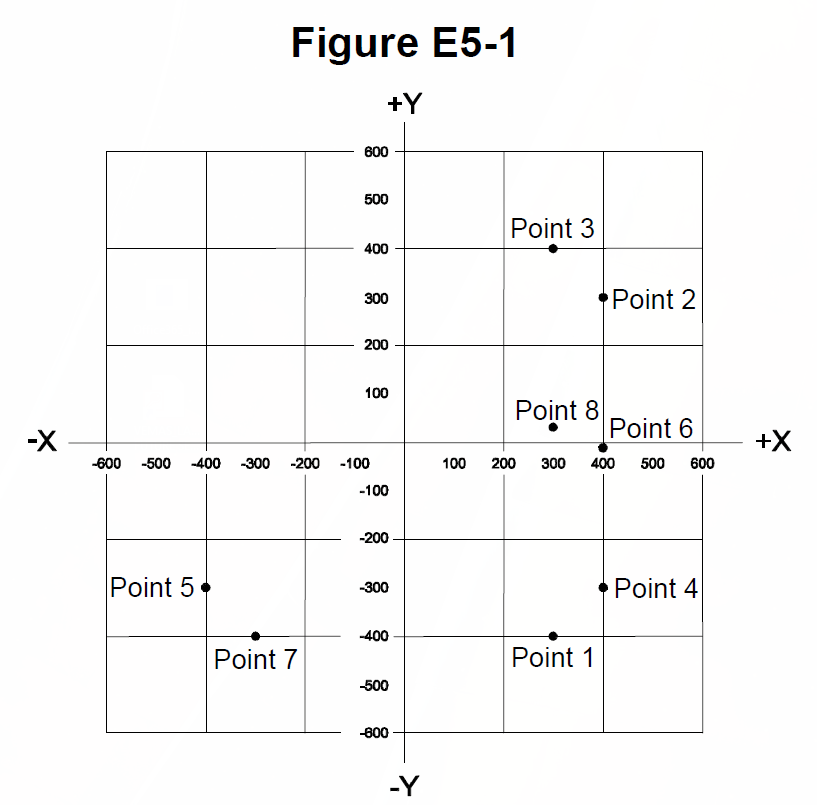
- APoint 2
- BPoint 4 Correct
- CPoint 5
- DPoint 6
Why: XC ≈ 1 ÷ (2π × 14 MHz × 38 pF) ≈ 300 Ω, so 400 − j300 = point 4.
- E5C11Question 11
Which point in Figure E5-1 best represents the impedance of a series circuit consisting of a 300-ohm resistor and an 18-microhenry inductor at 3.505 MHz?
- APoint 1
- BPoint 3 Correct
- CPoint 7
- DPoint 8
Why: XL ≈ 2π × 3.505 MHz × 18 µH ≈ 400 Ω, so 300 + j400 = point 3.
- E5C12Question 12
Which point on Figure E5-1 best represents the impedance of a series circuit consisting of a 300-ohm resistor and a 19-picofarad capacitor at 21.200 MHz?
- APoint 1 Correct
- BPoint 3
- CPoint 7
- DPoint 8
Why: XC ≈ 1 ÷ (2π × 21.2 MHz × 19 pF) ≈ 400 Ω, so 300 − j400 = point 1.